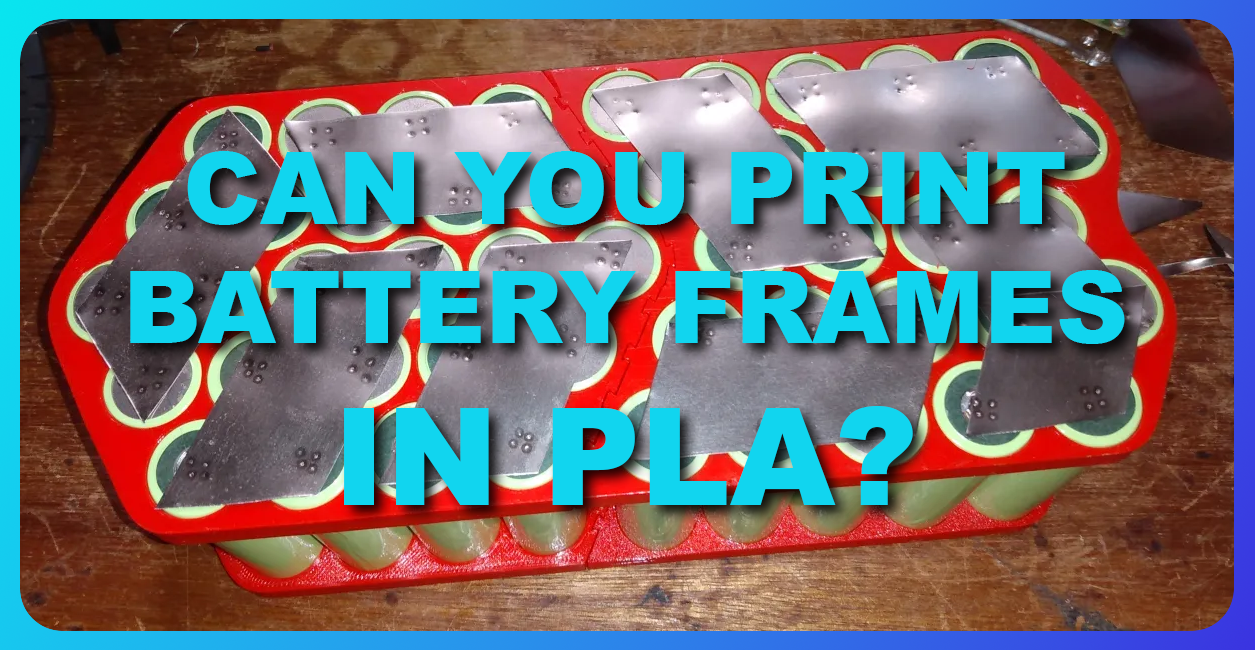
If you’ve spent any time around DIY battery builders (especially in the 3D-print world), you’ve probably heard the same warning over and over again: PLA gets soft at 60°C, so you can’t use it for battery frames.
On paper, that sounds convincing. Batteries can operate in temperature ranges where 60°C is possible. The fear is simple: the frame softens, the pack shifts, things deform, and suddenly your battery becomes a mechanical mess. The problem is, that doesn't account for the existence of TPU battery frames. At room temperature, TPU is much softer than PLA at 60C.
So, while it's true that at 60C, PLA will begin to soften, it’s also true that the frame doesn't have to ever be rigid.
The Conversation That Changed My Mind
Years ago when the battery designer software was still in its early alpha (it only generated SVGs and you had to manually stitch everything together in Tinkercad, Fusion, whatever) I got into this exact debate with a builder who used my program.
He told me he did everything in PLA. I gave him all the usual warnings: “You can’t because of this. You can’t because of that. PLA softens at 60C, that's within the operational range of a battery.”
And he basically said: “Joe, I’ve been building batteries for a long time. I know the math. I sell 20 to 30 batteries a week. It’s fine. I’ve been doing it for years.”
I didn’t want to argue. This wasn’t some armchair battery builder, this was someone running a serious operation and using my software to do it. So I let it go.
Then I Saw a TPU Frame
About a year later, I had gained much more battery-building experience and someone shipped me everything needed to build their battery. A case, cells, everything. And the frame was printed in TPU.
TPU. Super flexible. Soft. The exact opposite of what most people assume you want for a battery frame. But then I put the cells in it. Once the cells were seated, the whole thing turned into a solid brick. No wobble. No flexy frame feeling. You could press it with a fingernail and leave a crease, sure but as a structure? It was solid.
So, someone else out there in their world, through experimentation and iterative development has come to the conclusion that battery frames don't have to be rigid. You can put the rigidity on the outside of the battery with a good case, tight fitments, and proper mounting.
PLA at 60°C: Softening Isn’t Melting
The “PLA fails at 60°C” line is usually referring to PLA’s glass transition temperature (often around the mid-50s to mid-60s °C, depending on the specific PLA and print). That’s the point where PLA starts to lose its glassy stiffness and becomes noticeably softer.
But that’s not the same as liquefying. PLA doesn’t suddenly turn into a puddle at 60°C. It becomes more compliant. And that distinction matters.
If your frame spends brief periods near that range, such as during a very long, very hard pull, then cooling back down quickly.. PLA will operate totally totally fine in practice. This is also why the TPU frame example is so powerful: TPU is always softer than PLA, yet it still works because the design and the assembled system carry the load.
Sure, you don't want to build a 200 cell battery made out of PLA and mount it on a small peg in the middle in direct sunlight, because I can see the battery probably sagging over a long period of time. But really, who would do such a thing with any battery? No one. That’s who.
Is PLA The Best Material To Print Battery Frames?
Haha, no! Saying that PLA can and will work safely throughout the life of the pack doesn’t mean it’s the best choice. If we’re ranking common printing materials for battery work, PLA is probably the worst choice among the usual options. It does, after all, have the lowest heat margin.
But ‘not ideal’ is not the same as ‘impossible’ or ‘guaranteed failure’ or ‘unsafe’. In many real builds, especially where the pack is mechanically constrained, PLA frames can be perfectly acceptable.
Why Use PLA?
Let’s be honest. PLA is cheap and easy to print. Even the lowest end printers can print PLA decently. This makes it a lot better for production purposes. Also, it makes the pictures of your builds look a lot better if you don't have a more modern printer that can print higher temperature materials with a better finish.
The Real PLA Problem: UV Exposure
Heat gets all the attention, but UV exposure is brutal on PLA. Sunlight and long-term UV can degrade PLA over time, making it more brittle and weaker.
That’s why, even if you’re okay with PLA for internal frames, you generally don’t want PLA for external cases. This is especially true for anything that is always outside, on or in a vehicle, or anywhere the sun can hit it often and regularly.
Practical Recommendation: PETG (or Better) If You Can
If your printer can handle PETG reliably, that’s usually the smarter default for battery frames. PETG typically gives you a wider practical temperature window and better toughness for real-world abuse. Many builders use ABS, ASA, and other materials to print battery frames.
I’m not here to say PLA is ‘the best.’ It isn’t. I’m saying this:
You can print battery frames out of PLA and be fine. This is true so long as the pack design and enclosure are well done. If you can print PETG or exotic higher-temp materials, do it. But PLA isn’t an automatic failure the moment you see 60°C on a chart.
Safety Note
Lithium ion batteries can be dangerous if not properly engineered, built, or used, but honestly, you worry too much. You’re seriously overthinking it. These are batteries, not overclocked nuclear powered coverless woodchippers with anthrax coated blades in a literal final destination scene.
Don’t get me wrong, safety is important. The problem is, most people seriously overdo it. Erring to the side of caution simply doesn’t work in a production environment. When you are operating at any kind of scale, you kinda have to know what you’re doing.
If you are convinced that a battery has to be an absolutely rigid structure in order to be safe, then it's going to take more time designing and building a given battery than it otherwise would have. This can be fine on a small scale, a one off battery. But if you are making batteries, every dollar spent on material and every minute spent on procedure matters.
In that case it just makes a product you are selling more expensive and more time consuming to produce, but in other cases, it can limit you entirely. For example, what if someone wants a battery for a flexible longboard? Are you just going to argue with them about how the battery has to be rigid and bulky so you can only fit so many amp hours in it? Probably.
Sure, you want a properly supported battery, and you want flexibility to be predictable and generally limited to a single axis, but the welds and the series conductors can take it for the life of the pack if they are properly done. The frame does not have to be rigid. I have even seen them made out of a silicone-like substance.
Once you weld together a battery, it's a very rigid structure. Even if the frame itself is very soft. Ideally, you don't want the battery to hang in a fashion that places an uneven and unpredictable amount of stresses on the welds. This is why it's important to have a tight fit. If everything is properly sized and put together well, the resulting battery block will be rigid. It will feel like a solid brick.
With such a battery, special care has to be considered with how its packed and mounted, but alas, such a battery is possible and can be totally safe and reliable.
Conclusion
PLA really does start to soften around ~60 °C, but softening isn’t the same thing as melting. In assembled battery packs, welded cells plus a well-fitting frame can provide plenty of structural rigidity, and the widespread use of TPU frames that work well is proof that “it must be rigid” is an oversimplification. That said, UV exposure is a genuine weak point for PLA, so it’s a poor choice for cases that will be exposed to sunlight. If you have the option, PETG is usually the better all-around material for printing frames. Overall, PLA might not be the ideal material for battery frames, but in many real-world builds it’s far from the disaster people sometimes claim.