What happens if you charge a lithium battery with a regular charger?
It can be dangerous and damaging. Primary (non-rechargeable) lithium batteries should not be charged at all-attempting to charge them can cause leakage, venting, fire, or explosion.
Rechargeable lithium-ion batteries require a specific charging method (typically constant-current/constant-voltage, CC/CV) with a strict per-cell voltage limit. A “regular” charger (especially one meant for lead-acid or NiMH) may overcharge or overheat the pack, shorten its life, or in worst cases trigger thermal runaway.
Use a charger rated for the exact lithium chemistry and cell count, and a pack with proper protection/BMS.
Is It Okay To Leave A Lithium Polymer Battery On The Charger Overnight?
Safety depends on the charger and battery protection. With a quality, correct lithium charger and a healthy pack (and proper BMS/protection where applicable), it’s typically safe from an electronics standpoint-but it’s still not ideal to leave lithium packs charging unattended.
For longevity, holding a pack at 100% for long periods accelerates aging. If you must charge overnight, use a certified charger, charge on a nonflammable surface, keep it away from flammables, and consider stopping at 80 to 90% when possible.
What is the 80% Rule For LiPo Batteries?
It’s a battery-life practice: avoid routinely charging to 100% and avoid deep discharges. Keeping a lithium pack roughly in the middle of its state-of-charge window (often described as ~20%-80%) can reduce stress and extend cycle life.
For hobby LiPo specifically, a common best practice is to store the pack at “storage charge” (about 3.8 V per cell) when it won’t be used for a while.
What Are The Disadvantages Of Lithium Polymer Batteries?
Common disadvantages include:
- Higher sensitivity to physical damage (pouch can be punctured)
- Potential swelling with age/abuse
- Stricter handling/charging requirements
- Higher fire risk if overcharged, shorted, overheated, or damaged
- Less standardized form factors; may need mechanical support in some designs
What is BMS in a lithium battery?
A BMS (Battery Management System) is electronics that monitor and protect a lithium battery pack. It tracks cell voltages (and often temperature), limits charge/discharge current, prevents overcharge/over-discharge/short circuits, and may balance cells so they stay at similar voltages-improving safety and lifespan.
How do I reset a lithium battery BMS?
Use the manufacturer’s recommended procedure first. Many BMS units “reset” or “wake” automatically when the correct charger is connected, especially after an undervoltage cutoff.
- Disconnect loads and accessories.
- Let the pack rest briefly.
- Connect the proper charger to the pack’s charge port.
- Verify voltage (pack/cells) if the manufacturer provides a method.
Avoid risky methods like shorting terminals, bypassing protection, or “jumping” the pack with another battery-those can cause sparks, damage, or fire. If it won’t recover, the pack may have a failed cell group or a defective BMS and should be serviced or replaced.
Can I use a lithium battery without BMS?
In most multi-cell (series) lithium packs, you should not-safe operation and charging typically require protection and cell balancing. A single-cell (1S) battery may be used without a separate BMS only if the device/charger provides proper lithium charging and protection (or the cell has an integrated protection circuit).
Why Are Lithium Batteries Not Allowed?
They’re often restricted (especially in transport) because lithium batteries can enter thermal runaway and produce intense fires that are difficult to extinguish. Many air-travel rules prohibit spare lithium batteries in checked luggage and require them in carry-on, often with limits on watt-hours and quantity. The goal is to reduce fire risk and ensure any incident is noticed and handled quickly.
What Is The Biggest Cause Of Lithium-Ion Batteries Exploding?
Most serious incidents come from thermal runaway triggered by abuse or failure-commonly:
- Overcharging (wrong charger or failed protection)
- Physical damage (crush/puncture)
- Overheating
- Internal shorts (manufacturing defects/contamination)
Good cell quality, correct charging, and proper protection/BMS greatly reduce the risk.
Is It Safe To Store Lithium-ion Batteries In The House?
Yes, generally-people already store them in phones, laptops, tools, etc. For extra safety (especially for spares), store them cool and dry, away from heat sources and flammables, and protect terminals from shorting (original packaging or terminal covers/tape). For long-term storage, keep them partially charged (often ~30 to 60% state of charge).
Don’t store damaged, swollen, or overheated batteries indoors-dispose of them properly.
Do | Don’t
Use the correct charger for the exact chemistry and cell count | Charge non-rechargeable (primary) lithium batteries
Charge on a nonflammable surface and keep the area clear | Charge unattended if you can avoid it
Protect terminals from short circuits (covers/packaging) | Store damaged or swollen batteries indoors
Follow manufacturer guidance for BMS wake/reset behavior | Bypass protection circuits or “jump” packs
Store long-term at partial charge (often ~30 to 60%) | Keep packs at 100% for long periods when not needed
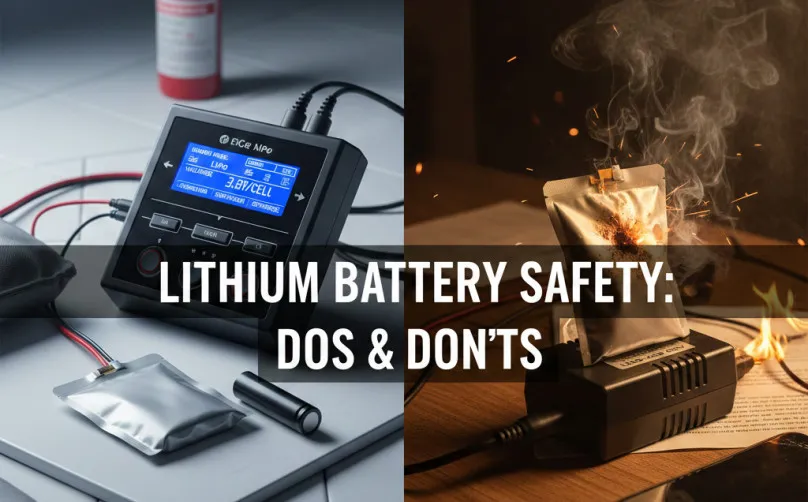
General guidance: If anything seems off-swelling, hissing, unusual heat, burnt smell, or rapid voltage drop-stop using the battery and follow safe disposal guidance.