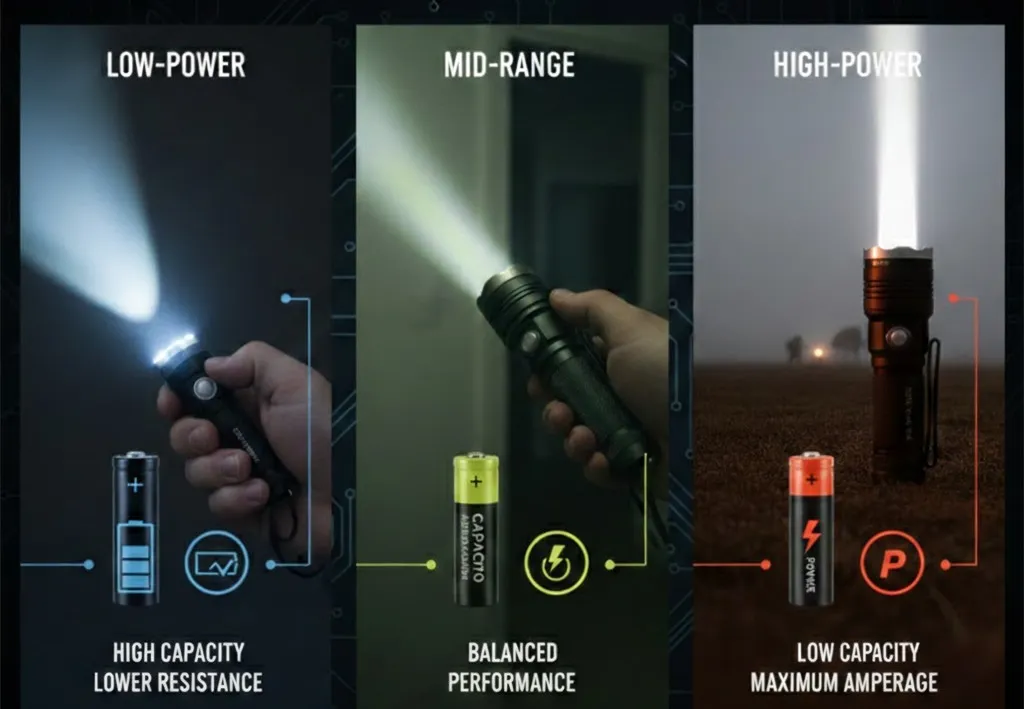
The best battery for a high-power flashlight is the Reliance INR21700 RS40, and the best battery for a mid-range flashlight is the EVE INR21700 50PL. Lithium-ion 21700 cells that use NMC chemistry have the most power and energy density compared to other common flashlight battery types. When it comes to finding the best battery for a high-powered flashlight, you will need to consider two important factors: capacity and resistance.
How To Pick The Best Flashlight Battery
You will often find that there is a tradeoff between capacity and resistance in a battery cell. In general, higher capacity cells tend to have higher internal resistance than higher power cells. This is due to the internal construction of the cell. Electrode area, current-collector design, and how much active material you can physically pack into the can have to all be considered when making a battery cell.
Generally speaking, you can either make a battery cell that has either a very low-resistance connection to the chemistry or lots of room for the chemistry itself. This kind-of makes sense, right? If you've got more room for very large electrodes that connect to many points (or just a large contact area to the chemistry), then you're going to have less room for the chemistry itself.
So that means there's really no way to overbuy in an attempt to under-worry because if you err to the side of capacity, you may not have the power that you need and if you err to the side of power, you will certainly be lacking in capacity. You have to know how much brightness you need to know how much current you need. Once you know how much current you will need, you have to know how long the flashlight can last at that brightness to know how much capacity you need.
If you try to just buy the highest-capacity, lowest-resistance cells, you will run into a problem because those goals are often at odds. So you kind of have to know which one you need (capacity or ampacity / low resistance) so you can optimize your purchasing decision. In this article, we will go over a few popular battery cells and explain their strengths and weaknesses when using them to run high power flash lights.
Flashlight Power Categories
First, let's break this down into two different categories: low end, average, and high power. We'll run the numbers for the average 'high brightness' flashlights and also actual high-end, high power flashlights. We won't spend any time on the lower-end flashlights.
Commodity-level low-end flashlights output somewhere around 200 to 600 lumens. When it comes to “high brightness” flashlights, regardless of what the packaging may claim (and some claim as high as a million lumens), they really output somewhere between 800 and 1,200 lumens initially. 'Initially' is important, because lithium ion, LED based flash lights will always have a higher initial brightness than there actual main-course running brightness.
Then, at the other end of the spectrum, you have those extremely bright flashlights that can throw massive columns of photons for extremely long distances. Flashlights on that level operate at about 2,500 to 5,000 lumens. So, basically, if you've got 2,500 lumens, you're going to have a very nice, strong, powerful beam.
Example Calculations
We will base these examples on 1,000 lumens and 3,000 lumens. 110 lumens per watt is a good mid-range figure to use for LED efficiency. These flashlights are operating in what's called a 1S configuration, so that means they're operating at the nominal voltage range of 3.7 volts. Considering these numbers, a mid-range high-brightness flashlight will draw about 9 watts (2.46A) from the battery while extremely bright flashlights that can light up entire fields at 3 a.m. will draw around 27 watts (7.37A) from the battery cell.
For our cell comparison, we’ll use:
- EVE INR21700/50PL: ~5000 mAh (minimum 4800 mAh), ≤ 7 mΩ resistance
- Reliance INR21700-RS40: 4000 mAh, ≤ 4 mΩ resistance
Resistance and Power Loss
For the mid-range flashlight that draws just 9 watts, the voltage drop experienced by the 7 mΩ cell is:
- Vdrop = I × R = 2.46A × 0.007Ω = 0.017V
- Power wasted inside the cell = I² × R = (2.46²) × 0.007 ≈ 0.042W
That’s only about 0.5% of the total power burned off inside the cell as heat, which is basically nothing. In contrast, if you use that same 7 mΩ cell in the high-brightness flashlight that draws 27 watts, this is the result:
- Vdrop = 7.37A × 0.007Ω = 0.052V
- Power loss = (7.37²) × 0.007 ≈ 0.38W
That’s about 1.4% of the total power. Still not catastrophic, but now it’s enough to contribute to extra cell heating and a little more voltage sag which will reduce peak brightness. So now let’s see what happens with the 4 mΩ cell under the same two circumstances.
For the mid-range flashlight:
- Vdrop = 2.46A × 0.004Ω = 0.010V
- Power loss = (2.46²) × 0.004 ≈ 0.024W (almost nothing)
And then with the high power flashlight:
- Vdrop = 7.37A × 0.004Ω = 0.029V
- Power loss = (7.37²) × 0.004 ≈ 0.22W (under 1%)
So at higher currents, lower-resistance cells waste less power as heat and hold voltage better, which helps sustain brightness and reduces thermal stress on the cell.
Now, just for comparison, here’s what a much higher-resistance 25 mΩ cell would look like under the same two circumstances.
For the mid-range flashlight:
- Vdrop = 2.46A × 0.025Ω = 0.062V
- Power loss = (2.46²) × 0.025 ≈ 0.15W (about 1.7%)
And then with the high power flashlight:
- Vdrop = 7.37A × 0.025Ω = 0.184V
- Power loss = (7.37²) × 0.025 ≈ 1.36W (about 5.0%)
5% power less would cause the battery cell to heat up pretty rapidly. You can see how resistance is important.
Factoring In Capacity
But that's just current performance. Once you factor in capacity, you can gain an even greater understanding. In our example the 7 mΩ cell (EVE INR21700/50PL) is a 5000 mAh battery (4800 mAh minimum). The 4 mΩ cell (Reliance INR21700-RS40), on the other hand, is 4000 mAh.
For the mid-range flashlight (2.46A draw):
- EVE 50PL (5000 mAh): 5.0Ah / 2.46A ≈ 2.0 hours
- Reliance RS40 (4000 mAh): 4.0Ah / 2.46A ≈ 1.6 hours
In the high-brightness (27-watt) flashlight (7.37A draw):
- EVE 50PL (5000 mAh): 5.0Ah / 7.37A ≈ 41 minutes
- Reliance RS40 (4000 mAh): 4.0Ah / 7.37A ≈ 33 minutes
So in mid-range use, capacity tends to dominate the decision. In high-power use, resistance (and how well the cell holds voltage under load) matters more and you simply have to accept the runtime hit that comes from using a 'power cell.'
So, What Does It All Mean?
This highlights two practical truths:
- Higher resistance = more wasted heat and more voltage sag, especially as current climbs. That heat contributes to faster cell aging over time.
- Mid-range flashlights don’t pull enough current for resistance differences to matter much, so you can optimize mainly for capacity and runtime.
So basically, if you're shopping for battery cells for a flashlight and it's for a standard mid-range, high-brightness flashlight, then you want to shop based on capacity, you want as much runtime as you can reasonably get. But if you are shopping for a battery for one of those extremely high-powered flashlights, then low resistance and strong high-discharge performance should take priority over absolute capacity.
So, What Is The Best Battery For High Power Flashlights?
It depends on what you mean by high power. If you're talking about your standard issue high-brightness flashlight that can be used to effectively light up a completely dark house, then that will be the EVE INR21700/50PL, with its ≤ 7 mΩ of resistance and 5000 mAh of capacity (4800 mAh minimum). It has plenty of discharge capability for this class of light, and it gives you excellent runtime.
In contrast, if you're talking about a very high-end powerful flashlight that you would use to light up a massive empty field in the middle of the night (and especially one that pulls very high current on turbo), then the Reliance INR21700-RS40 is a much better option. Even though it’s only 4000 mAh, its ≤ 4 mΩ internal resistance and very strong continuous discharge rating help it waste less power as heat, hold voltage better under load, and maintain higher real-world brightness at the top end.