By comparing real datasheets, we can see that a continuous heat dissipation of about 0.35 watts per cubic centimeter is a common, conservative limit that aligns well with how cells are actually rated. Using this value, we first calculate how many total watts of heat a cell of a given size can safely dissipate, then use the cell’s measured internal resistance to calculate the maximum continuous current that would produce that amount of heat.
The result isn’t a perfect or guaranteed rating—but it’s far more grounded in physics and real-world data than guessing, marketing claims, or assuming ideal conditions.
BS
Bryan Sacks · Founder, Cell Saviors
Guide · 9 min read · Published Feb 10, 2026 · Updated Oct 2, 2026
When a lithium-ion cell’s official current rating is unknown, we can still make a reasonable, defensible estimate by working backward from heat.
Every cell generates heat in proportion to its internal resistance and the square of the current flowing through it. Because cylindrical lithium-ion cells of the same size are built from very similar materials and have nearly identical thermal behavior, manufacturers tend to tolerate roughly the same amount of waste heat per unit volume. By comparing real datasheets, we can see that a continuous heat dissipation of about 0.35 watts per cubic centimeter is a common, conservative limit that aligns well with how cells are actually rated. Using this value, we first calculate how many total watts of heat a cell of a given size can safely dissipate, then use the cell’s measured internal resistance to calculate the maximum continuous current that would produce that amount of heat.
The result isn’t a perfect or guaranteed rating-but it’s far more grounded in physics and real-world data than guessing, marketing claims, or assuming ideal conditions. In this article, we will explain how you can estimate the maximum amount of safe current to draw from an unknown cell.
What Cell Ratings Are Really About
So, what do the continuous and maximum current ratings on lithium-ion cells really mean? How does a manufacturer determine if a given cell can do 7 amps or 10 amps continuously or 20 or 40 amps in peak? Is it just random? Are they just guessing? Is it after some experimentation? Do they wait for one to explode and then record how much current it took to do that? What is the process? Well, I can't exactly tell you their process because I don't work at those cell manufacturing companies.
But I can tell you how the continuous and peak current figures relate to a physical property of the cell, which is the resistance. It also relates to the size of the cell. But because we are dealing with cylindrical cells that come in standard package sizes, we don't have that many options to deal with that. In this article, we're going to discuss how the ratings for a given cell relate to its resistance and size. And we will also show how to determine reasonable ratings for an unknown cell based on its size and resistance alone.
Voltage Drop, Resistance, and Heat
When you place a load on a cell, whatever its voltage is before that load will be dropped by some amount proportional to the amount of current that the load is. That drop in voltage computed with the current can tell you how many waste watts of heat are dispersed into the cell. It might be 3 watts, it might be 10 watts, and the watts are not directly related to temperature on their own.
For example, if you have a very large item, like something the size of a basketball, and you put 10 watts of heat into it, it might get warm to the touch, and that's about it. But something the size of a battery cell, even a larger one like a 21700, if you put 10 watts of heat into that, it will get burning, burning, burning hot. It's not just the physical size, it's also the material and other properties that are computed along with the watts to determine a rise in Celsius.
Why Size And Materials Matter
While it's true that no two battery cells, even from the same manufacturer and produced on the same assembly line, are going to be identical, they are not all that different on the level I'm talking about here. What I mean is, if 6 watts makes one 21700 cell hot, and it raises its temperature a particular amount above ambient, then you can pretty much bet on the same amount of watts doing the same thermal things to a totally different cell, because they're all going to weigh about the same, and they're all going to have similar material properties in terms of how heat affects them and moves through them.
Where Cells Differ Most: Waste Watts Per Amp Of Current
What can be drastically different cell to cell is how many waste watts are generated for a given amount of current. For a low resistance cell, you will have much less waste heat generated for the same amount of current than you would for a higher resistance cell. So in that way, cells can have drastically different thermal performance for a given load. So, while a given cell may produce more or less heat given a particular load current, the effects of that heat, per watt, will affect just about any cell the same. This is because they're all made of pretty much the same stuff, packaged in pretty much the same way, and they are pretty much the same exact size. Of course, that means the same amount of watts of heat will be much hotter to an 18650 than it would be for a 21700.
Make no mistake, however. There are some cells that are specifically designed to handle the higher temperatures that are achieved under these circumstances. For example, a high end EVE cell will be able to operate up to 80C. There are other cells that you ABOSLUTELY do not want to let get that hot, as they just cant handle it. This is why the more conservative figure of 0.35 watts per cubic centimeter is used.
Looking at real datasheets to calibrate expectations
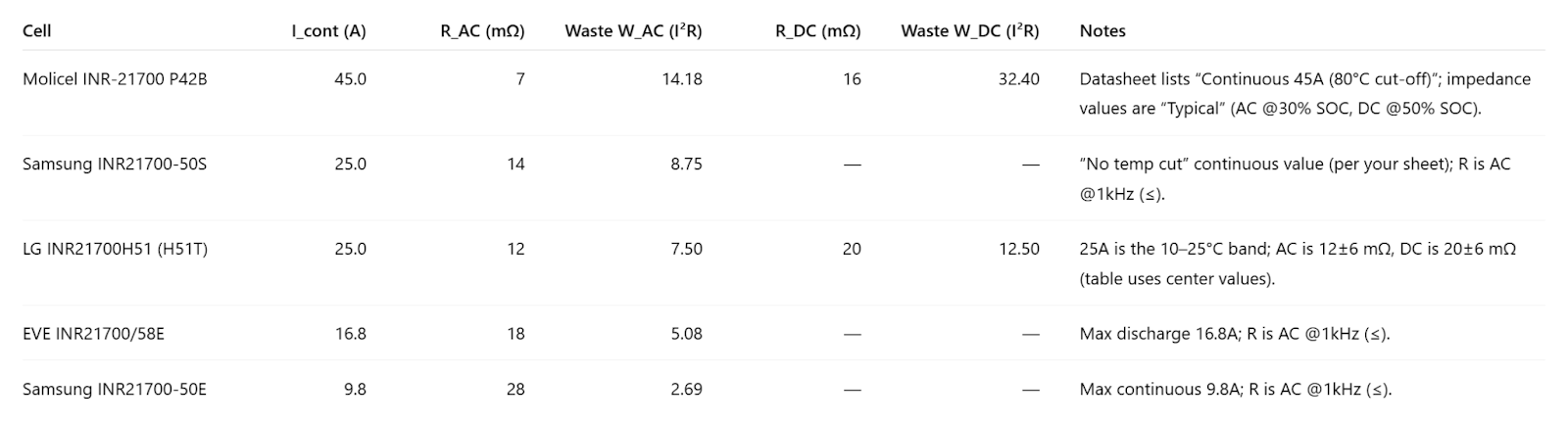
So with all of that understood and in mind, before we do any calculations on our own to determine how many amps a given cell with a given resistance can support, we're going to go ahead and look at a few popular lithium ion battery cell data sheets, and we're going to see what the resistance of those cells are and what the maximum current that the manufacturers say that they support on a continuous basis. And then we'll compare that to the amount of waste watts that are dispersed into the cell under those conditions to kind of get a feel for what the manufacturers of these cells consider okay in terms of watts of heat dispersed into them.
Popular Cell Comparisons
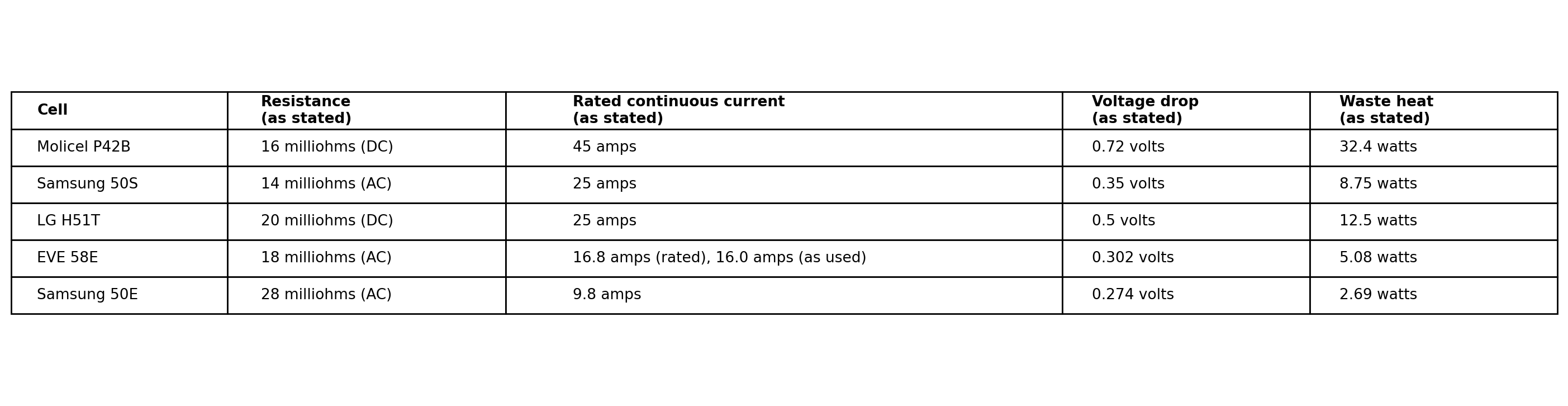
First up we have the M P42B. According to Molicel, this cell has a DC resistance of about 16 milliohms. That means that under the rated continuous current of 45 amps, its voltage is going to drop by about 0.72 volts.
This is going to result in a staggering 32.4 waste watts of heat. Now let's compare that to how Samsung rates the 50S. They rate it for 25 amps and they state an AC resistance of 14 milliohms which produces a 0.35 volt drop at the rated current of 25 amps. This produces just 8.75 watts of heat which is still a lot for a battery cell.
Moving on to the LG H51T, it's rated for 25 amps and they give it a DC resistance of 20 milliohms. This produces a half a volt drop at the same 25 amps that only took the Samsung 50S down by 0.35 volts. Due to the slightly higher resistance, this LG H51T produces 12.5 watts of waste heat within the cell under that load.
Then we have the EVE 58E. It's rated for 16.8 amps and has a rated AC resistance of 18 milliohms. This produces a 0.302 volt drop under the rated 16.0 amps of current resulting in 5.08 watts of waste heat.
And then finally we have the Samsung 50E. This is known to be a pretty low end cell supporting officially just 9.8 amps continuously. It has a stated 28 milliohm AC resistance which produces a 0.274 volt drop at the rated 9.8 amps of continuous current. This causes 2.69 watts to be dissipated within the cell.
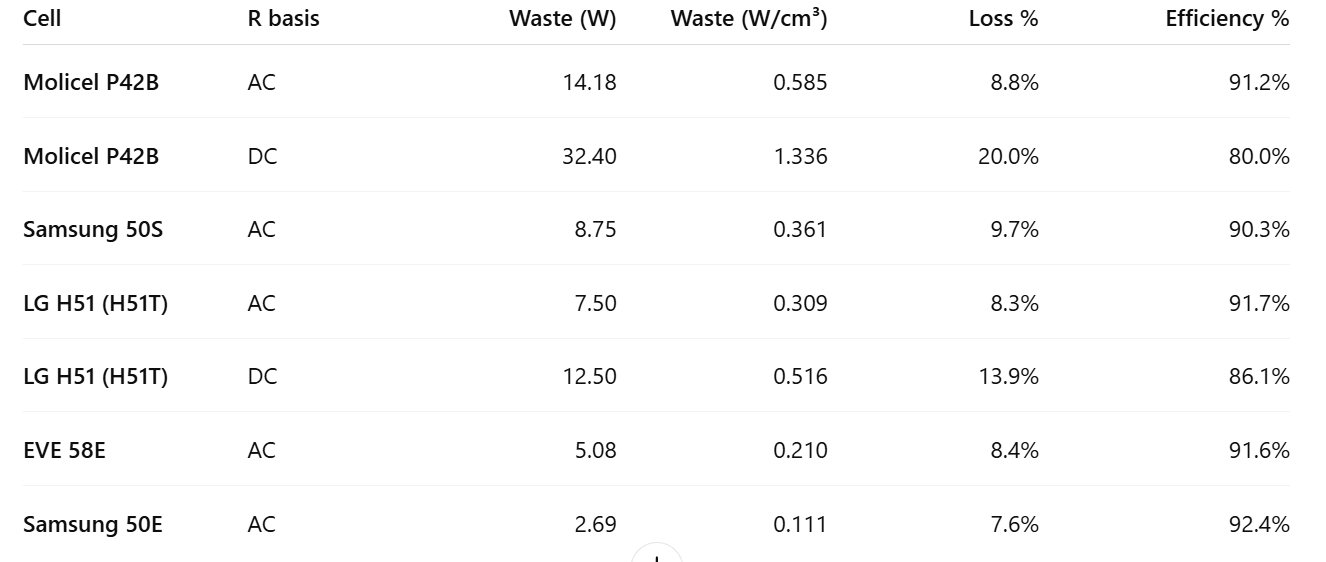
We can see from the table that the cell manufacturers are all over the place in terms of what they consider acceptable or okay.
Comparison table
Rule of Thumb
So we can pretty much see a general trend. While it's true that all of these cell manufacturers consider a different amount of waste heat per cubic centimeter to be acceptable in a given cell, they all kind of hover around the 90% efficient mark. So personally, I think that's a good rule of thumb. If you want to rate the cells similar to how the manufacturers rate them, but you don't know the official rating, you can just measure the resistance and then consider the size and its losses. And the fact that these cells are roughly the same size. And they're using basically the same chemistry. So the differences in how the cell manufacturers rate them are really just for marketing. It's to find the best balance of marketing and actual performance.
If you want to use something more tied to the size of a cell, then 0.35W waste watts of heat per cubic cm of cell seems to be the average acceptable continuous amount of heat according to cell manufacturers.
Will using these estimates provide a perfect, scientifically accurate rating for an unknown cell? Absolutely not, but its a whole lot better than simply guessing, or assuming the cells you have are brand new and can perform at the rated current.
Example Calculations
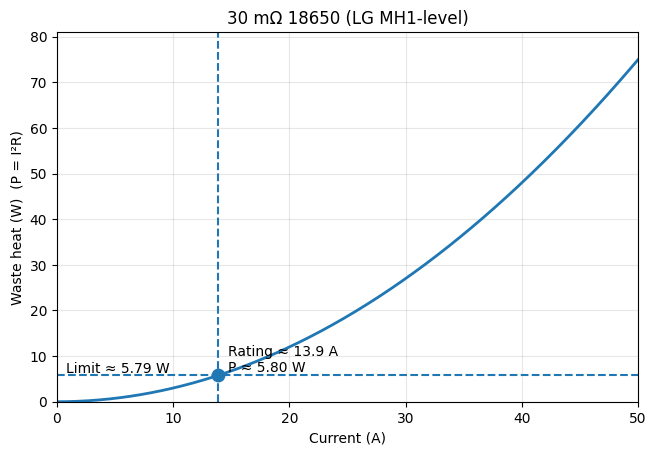
30 mOhm 18650
This cell represents something on the level of an LG MH1
An 18650 cell is about 18 millimeters in diameter and 65 millimeters long, which is a radius of 0.9 centimeters and a length of 6.5 centimeters. Treating it as a cylinder, its volume is pi times radius squared times length, so pi times 0.9 squared times 6.5 which is about 16.54 cubic centimeters. With a limit of 0.35 waste watts per cubic centimeter, the maximum total waste power is 0.35 times 16.54 which is about 5.79 watts. If the cell has 30 milliohms internal resistance, that is 0.03 ohms, and resistive waste power is current squared times resistance, so current is the square root of waste power divided by resistance, giving the square root of 5.79 divided by 0.03 which is about 13.9 amps.
15 mOhm 21700
This cell represents something on the level of a Molicel P42A
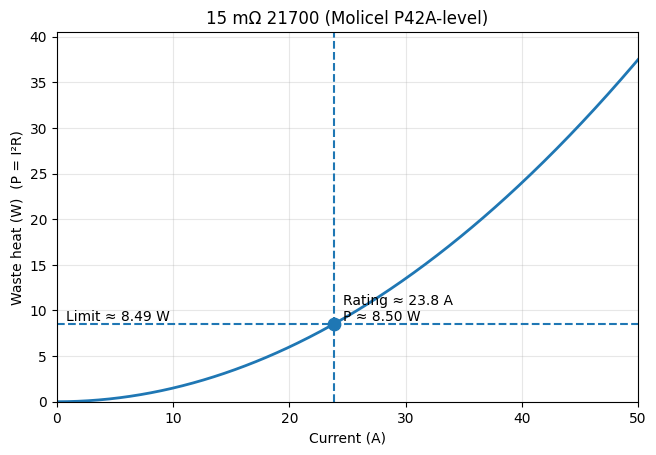
A 21700 cell is about 21 millimeters in diameter and 70 millimeters long, which corresponds to a radius of 1.05 centimeters and a length of 7.0 centimeters. Approximating the cell as a cylinder, its volume is pi times the radius squared times the length, which is 3.1416 times 1.05 squared times 7.0, giving a volume of about 24.25 cubic centimeters. With a waste heat limit of 0.35 watts per cubic centimeter, the maximum allowable waste power is 0.35 times 24.25, or about 8.49 watts. If the internal resistance of the cell is 15 milliohms, which is 0.015 ohms, the resistive heating is equal to current squared times resistance, so the allowable current is the square root of the waste power divided by the resistance. Taking the square root of 8.49 divided by 0.015 gives a current of about 23.8 amps.
4 mOhm 21700
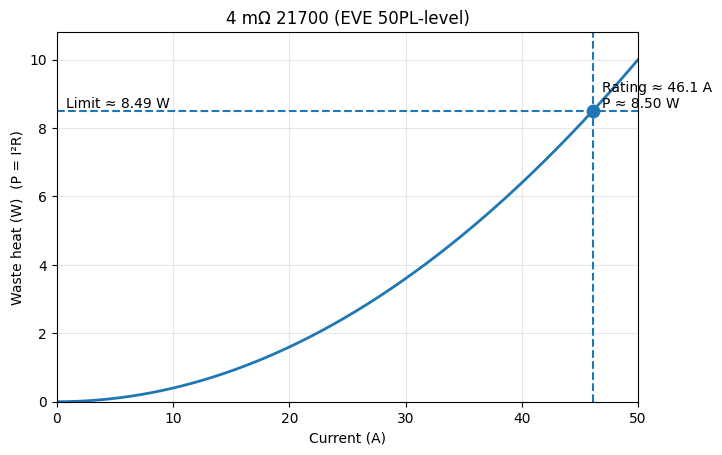
This cell represents something on the level of an EVE 50PL. A 21700 cell is about 21 millimeters in diameter and 70 millimeters long, which corresponds to a radius of 1.05 centimeters and a length of 7.0 centimeters. Approximating the cell as a cylinder, its volume is pi times the radius squared times the length, so pi times 1.05 squared times 7.0, which is about 24.25 cubic centimeters. With a waste heat limit of 0.35 watts per cubic centimeter, the maximum allowable waste power is 0.35 times 24.25, which is about 8.49 watts. If the internal resistance of the cell is 4 milliohms, that is 0.004 ohms, and resistive waste power is current squared times resistance, then the allowable current is the square root of the waste power divided by the resistance. Taking the square root of 8.49 divided by 0.004 gives a current of about 46.1 amps.
Conclusion
So, they are not exactly what the cell manufacturer say, but its pretty close to the real world reports from battery builders. Why are they not perfectly in line with the ratings? Because both are just estimates of how much heat the cell can handle continuously. The difference is, their motive is to tell you that the cell can handle as much heat as possible, where my motive is to find a good rule of thumb to use when a cell rating is unknown. My estimate is based on the common sizes of the cells and the fact that most of them have a nearly identical construction and chemistry composition.
We hope this article helped you learn how to estimate the ampacity of a cell based on its resistance and size, thanks for reading!
Bryan has worked with electronics since he was a kid and builds the packs these guides and tools come from, with a background in design and development.