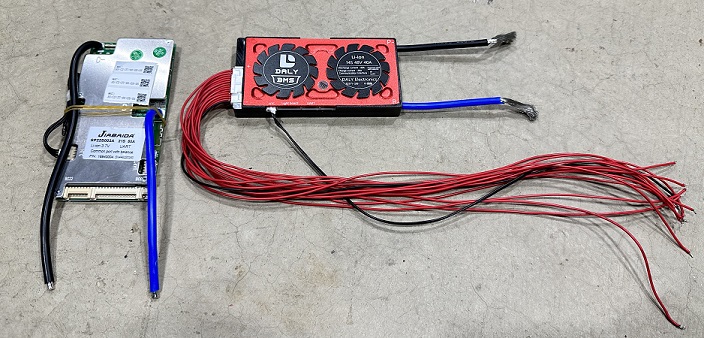
Choosing the wrong BMS is one of the most expensive mistakes in DIY battery building. Too small and it shuts down under load or blows a FET. Too weak on the balance current and your cells drift over months. This guide covers what actually matters when selecting a BMS for lithium battery packs.
If you want to skip straight to filtering by series count, continuous amps, and chemistry, use the BMS Picker.
NMC/NCA vs LFP: the voltage difference matters
The most important thing to get right before anything else: NMC and NCA cells charge to 4.2V per cell. LFP cells charge to 3.65V per cell. A BMS designed for NMC at 4.2V per cell will overcharge LFP cells. A BMS designed for LFP at 3.65V per cell will undercharge NMC cells and leave capacity on the table.
Buy a BMS spec'd for your chemistry. Some modern BMS units have configurable cell voltage limits — confirm the voltage range covers your target before buying.
Series count (xS)
The series count must exactly match your pack configuration. A 4S BMS for a 4S LFP pack. A 7S BMS for a 7S NMC pack. No exceptions. The BMS monitors each cell group's voltage individually. A BMS with the wrong S count will give incorrect readings and may not balance or protect correctly.
Common configurations:
- 4S LFP = 12V nominal (13V charged)
- 8S LFP = 24V nominal (29.2V charged)
- 16S LFP = 48V nominal (58.4V charged)
- 13S NMC = 48V nominal (54.6V charged)
- 7S NMC = 25.9V nominal (29.4V charged)
Continuous current rating
The continuous current rating is the maximum sustained discharge current the BMS can handle without overheating. Match this to your load, not your cells.
If your inverter pulls 50A and your cells can deliver 200A, you still only need a 50A BMS (or a bit more for headroom — 60 to 80A is a reasonable buffer). Oversizing is fine. Undersizing triggers protection cutoffs at the worst possible moment.
Peak current ratings are usually 1.5 to 2x continuous. Some inverters draw a surge at startup that exceeds the BMS's continuous rating but stays within the peak rating. Check your inverter's startup current spec.
Balance current
Passive balancing bleeds off charge from the highest cells to bring them in line with the rest. The balance current is how fast that happens — typically 50 to 300 mA for passive BMS units.
Higher balance current means faster convergence. A 100 mA balance current on a cell that's 500 mAh out of balance takes 5 hours of balancing just to close that gap. For large LFP prismatic packs (100Ah+), you want at least 200 mA. Some Daly and JK BMS units go to 2A or more for active balancing.
Active balancing moves energy from high cells to low cells instead of wasting it as heat. More efficient but more expensive. For large packs that sit at a low state of charge regularly, active balancing pays off.
Common port vs separate port
A common-port BMS uses the same terminals for charging and discharging. A separate-port BMS has dedicated charge and discharge terminals.
Common port is simpler to wire. Separate port lets you apply the BMS's discharge cutoff without it also cutting charge — useful for systems where you might want to charge a deeply discharged pack even if a load is connected. For most DIY builds, common port is fine.
Bluetooth and monitoring
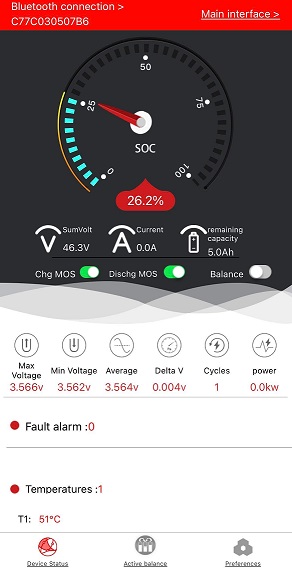
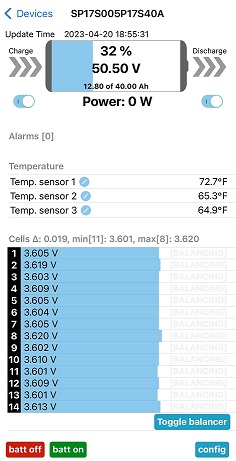
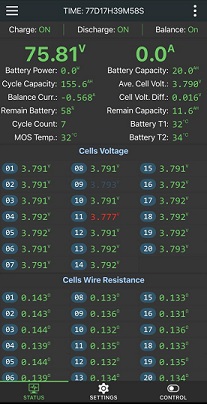
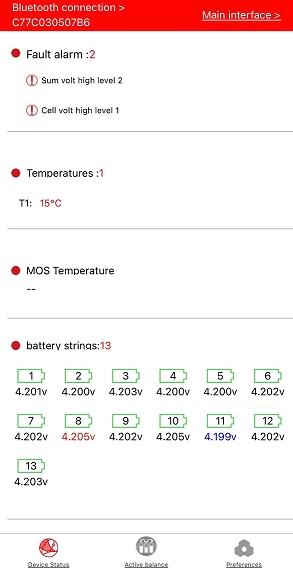
BMS units with Bluetooth (JK, ANT, some Daly models) let you see per-cell voltages, temperatures, fault history, and current on your phone. This is worth having if you're building a permanent installation you'll rely on. You'll catch a drifting cell before it causes problems. For a simple pack you can inspect directly, it's optional.
Waterproofing
For outdoor, marine, or EV applications, check the IP rating. Most basic BMS units are bare PCBs — fine for protected indoor use, bad for anything that might see moisture or condensation. Look for conformal coating or a potted unit for wet environments.
Temperature sensing
Most BMS units include at least one NTC temperature probe. Better units have multiple sensors and configurable over-temperature cutoffs for both charging and discharging. For LFP at low temperatures (below 0°C), you want charge protection — charging LFP below freezing causes lithium plating and permanent damage.
Recommended BMS units by application
Rather than list specific models here (prices and availability change), use the BMS Picker to filter by series count, continuous amps, chemistry, and whether you want Bluetooth. The picker links directly to current stock.
FAQ
- Can I use one BMS for both NMC and LFP?
- Only if the BMS has configurable cell voltage limits that cover both ranges. Most fixed-chemistry units cannot do this safely. Check the specs carefully.
- What happens if my BMS is undersized?
- It will shut down under load (discharge overcurrent protection), potentially at the worst moment. Sustained overcurrent also overheats the FETs and shortens the BMS's life. Size for your actual load with 20 to 30% headroom.
- Do I need a BMS for LFP cells?
- Yes. LFP cells have a flatter discharge curve than NMC, which makes cell-level voltage monitoring harder without active BMS monitoring. An imbalanced LFP pack can damage cells before the terminal voltage shows anything obviously wrong.
- What's the difference between a 4S and a 4S4P BMS?
- None — BMS series count refers to the number of cell groups in series, regardless of how many cells are in parallel within each group. A 4S BMS works for 4S, 4S2P, 4S4P, and so on.