Table of Contents
Why Sodium-Ion Is Getting Attention
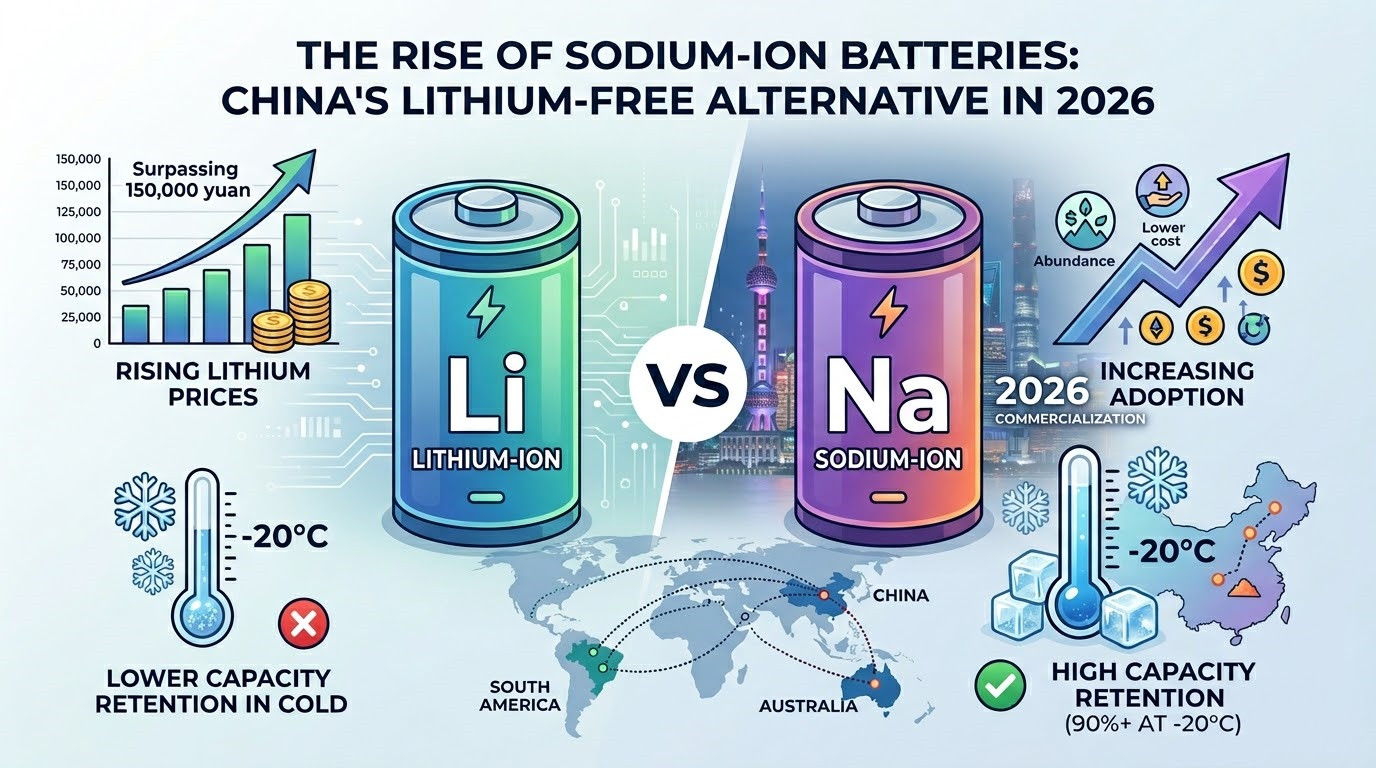
China’s battery industry is putting real weight behind sodium-ion tech as lithium gets more expensive and big manufacturers ramp up production. What I'm saying is.. companies want a battery chemistry that’s cheaper, easier to get, and better suited to things cold weather.
Sodium’s Supply Advantage
Sodium is absolutely everywhere. It’s way, way more common in the Earth’s crust than lithium. With lithium.. the supply is essentially bottlenecked, so its a lot more vulnerable. Sodium ion gives battery makers a way to reduce exposure to price swings and supply chain problems.
Lithium Prices Are Creating Pressure
Sodium ion is starting to look good. It makes sense because the price for raw lithium is starting to climb. Recently this year, the price for lithium carbonate broke the 150,000 yuan (21,734 USD) per ton barrier, hitting 170,000 yuan (24,632.32 USD) per ton. That kind of price rise is going to place pressure on entry-level EV makers, especially the ones relying on LFP batteries, where cost control matters a lot.
China’s Manufacturers Are Moving Fast
CATL recently rolled out a sodium-ion battery for light commercial vehicles and said passenger-car use is expected in the second quarter of 2026. The first reported model is the Aion Y Plus. And it’s not just CATL. In fact, BYD has even started up a 30 GWh sodium-ion battery production line. Also, EVE Energy has launched a 1 billion yuan (150M USD) sodium-ion project.
Ronbay Technology is another company that has shifted part of its lithium battery production over to sodium-ion materials. Shipments are also moving. It's important to note that global sodium ion shipments have hit about 9 GWh in 2025. That is pretty substantial, as its a 150 percent increase year over year.
Performance and Cost Benefits
The appeal is straightforward. Sodium ion batteries work better in the cold compared to lithium. This gives them an edge in certain use cases. Shockingly, some recent sodium ion prototype cells have seen an over 90 percent retention of their capacity at -20 °C. In contrast, standard lithium batteries are closer to 80 percent.
The materials can also be 30 to 40 percent cheaper than lithium-based alternatives, though total costs still depend on manufacturing scale and how mature the supply chain gets.
The Main Limitation: Energy Density
Energy density is still a major, major problem. Sodium-ion batteries can only do around 100 to 170 watt hours per kilogram. That is well below LFP's batteries 180 to 200 Wh/kg, and way, WAY below 'standard' lithium (NMC) batteries that can do 250 to 300 Wh/kg.
Sodium Ion Still Can't Replace Lithium
So, regardless of the recent advancements and industry moves.. these sodium bats aren't gonna be viable for long-range EVs. Production scale and supplier coordination still have a long way to go as well.
Where Sodium-Ion Fits First
You would be crazy to think that sodium-ion to replace lithium any time soon. Coming back down to earth, we can expect Sodium Ion batteries to fill specific roles first. Things like entry-level EVs, cold-weather markets, and stationary energy storage. The broader takeaway is that China is moving faster on commercialization, and 2026 looks like a real inflection point.
Turn the guide into a real build plan
If this article is part of an actual battery, powerwall, or pack-design project, the next step is usually moving from theory into the calculators and planning tools.