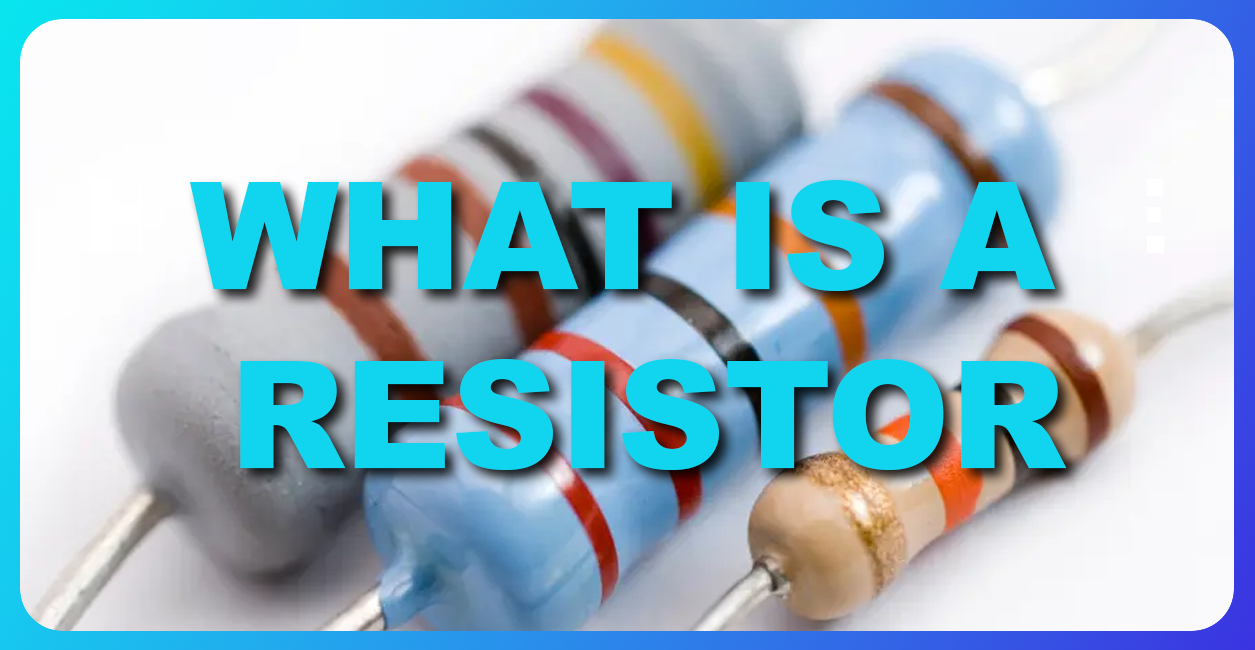
A resistor is a fundamental electronic component that slows down the flow of electricity. A lot of people like to think of electricity like water flowing through a pipe, and while that's not exactly accurate, it is useful in the absence of anything else. If you're going the water route, you can think of a resistor like a narrow section of pipe, and it makes it harder for the water to flow.
The Water Analogy (and the Hose “Thumb” Example)
At first, this might seem contradictory to your experience with water because if you put your thumb over the end of a water hose, we all know the water comes out faster, and that seems like you've increased the pressure. But actually, you've decreased the pressure a tiny amount, and you've increased the speed a dramatic amount, because when you create an obstruction, you are indeed decreasing the pressure after that obstruction.
But if you take whatever decreased pressure it is (because it's only a small amount) and you distribute that pressure over a much smaller opening, the overall force of it coming out is higher per unit of volume. Overall, it is lower because of the obstruction.
How a Resistor Works in a Circuit
Moving on from the water analogy, this is how a resistor actually works. It's an electronic component that opposes the flow of electric current. The voltage going into a resistor is always more than the voltage coming out of a resistor when there is an above-zero amount of current flowing.
For every unit of current that's flowing, the voltage drop through the resistor increases proportionally. So, if you have a resistor that has 5 volts going in and 5 volts going out, then you know no current is flowing. Again, if you measure both sides of a resistor that's in series with a circuit and you measure no millivolts-absolutely no voltage-then you know that no current is flowing.
If any amount of current is flowing and you have 5 volts going in, you will have less than 5 volts going out. The amount that is subtracted from the input voltage is directly proportional to the resistance of the resistor itself and the amount of current flowing through it. If whatever resistor you have drops by 1 millivolt under 1 amp, it will drop by 10 millivolts under 10 amps. The relationship is exactly linear.
Temperature Effects and Linearity
The resistance of things changes with an increase in temperature; however, under most circumstances this is small and nearly negligible. For example, you have to bring copper to 60 degrees Celsius to see even a 12 to 15 percent increase in resistance.
So overall, this figure is linear, with the exception of some dampening at the higher end due to higher currents.
Heat and Power Loss (What Isn’t Linear)
But what is not linear is the relationship to heat. While it's true that if you have twice the current, you will have twice the amount of voltage drop, if you have twice the voltage drop, you have 4 times the amount of power loss. The amount of power loss in a conductor is current squared times voltage, not just current times voltage.
So the more and more current you have passing through it, the heat will add up quickly. If you overload something, the effects of temperature on resistance will be much more drastic and nowhere near negligible. Resistors dissipate the lost energy as heat, and that's something that should always be accounted for.
So you might think if you have a very high resistance and you connect that to positive and negative that it will produce a large amount of heat. Well, if the resistance is high enough, it will cause the voltage dropping, or it will cause the voltage going into it to drop so much that by the time the voltage is coming out of it and back into the circuit, the voltage has dropped so much that there's just not a high enough voltage for a meaningful amount of watts to be transferred.
What Resistors Are Used For
So what are resistors used for? They're used to protect parts to keep current intentionally below a safe level. They're used to set voltages. If you put two resistors in series and they have the same value, then the voltage at the midpoint will be half of the voltage at the input.
And the voltage of the midpoint is proportional to the amount of resistance on either side of the midpoint. So if you put most of the resistance on the positive side, then the voltage will lean more heavily towards the lower side.
Resistors are also used with capacitors in what are called RC circuits to create simple oscillators to control timing. You can also use a resistor or set of resistors to bias a transistor or other active components so they can operate under optimal conditions given the circuit that they are in.
Sometimes you actually want a high resistance for the configuration of circuits-setting voltages, making voltage dividers, setting up sensors, etc. Other times you want the lowest possible resistance, such as in your battery cells, in your connectors, in the cables that connect your load to the power supply, and so on.
What Resistance Really Is
So what really is resistance? Electric current happens when an electric charge moves through a material. In the case of a resistor, the material and the structure of the resistor itself make that motion more difficult to happen. This is because the moving charges literally collide with atoms and other imperfections in the material.
When those collisions happen, it slows the average drift of the charge carriers. So for a given input voltage, you get less current. How hard something is to move through is measured in ohms.
What Sets a Resistor’s Value
So what exactly sets the resistor's value? There are several factors:
- Material: The material used has an intrinsic resistance. How strongly does a given material impede the charge motion? That is considered when selecting the material for resistance.
- Length: The longer the path you have, the higher the resistance. So that is also used to manufacture resistors to a certain resistance.
- Cross-sectional area: Also known as the thickness along the axis of current travel. If you have a wider cross-sectional area, you'll have a lower resistance given the same length.
- Temperature: Temperature will change the resistance of all resistors. Most of them only change a tiny little bit. Some of them change a whole lot. In fact, some of them are designed to change as much as possible. These are called thermistors.
Thermistors form one half of a voltage divider, where the other half is a fixed resistor. And that swings a voltage range so you can measure temperature.
Review and Key Formulas
So to review: Resistors are components that oppose the flow of electric current. They are used to control how much current can move in a given circuit and how voltage is distributed.
The behavior of a resistor will always follow Ohm's law: V = I × R. If you increase the resistance, it will reduce the current for a given voltage.
Another important fact about resistors is that they create a voltage drop that is equal to resistance times current when current is flowing.
And 100% of the energy that is used in a resistor to do its job becomes heat-even if that is a tiny, indetectable amount of heat. It is described by the power formula, which is: P = V × I if the resistor itself is the load. If the resistor is in series with the load, then it's: P = I² × R (or I squared times R).
Closing
We hope this article helped you learn everything you need to know about the humble resistor. Thank you for reading.