The Problem With Nominal Voltage
Have you ever noticed that the nominal voltage for lithium ion batteries is inconsistently represented across different data sheets or marketing materials?
Have you ever noticed that the nominal voltage for lithium ion batteries is inconsistently represented across different data sheets or marketing materials? That's because nominal voltage is really just a concept that's used to better understand lithium ion batteries from a perspective of no electrical knowledge.
What Is Nominal Voltage?
When you don't have a lot of experience with volts and no experience with amps and ohms, the easiest way to understand if a battery will work with a particular thing is to match the voltage. That's why we have things that are rated for 12 volts and we have things that we call 12 volt batteries, but there is actually no such thing as a 12 volt battery.
It doesn't matter what chemistry you're using-it could be lead acid cells where you need six in series and they have a two volt nominal voltage, or it could be NMC lithium ion cells that have 3.6 or 3.7 volt nominal chemistry depending on who you ask, where you need 3 cell groups in series, or an LFP pack that requires 4 cell groups in series.
Either way, you're not making a 12-volt battery. Now, depending which path you go down, you will find better or worse compatibility with 12-volt devices. But in none of those situations are you making a 12-volt battery. You're not making a battery that is 12 volts most of the time or even some of the time. It's literally 12 volts never of the time.
That's because nominal voltage isn't really a real thing. It's not something that we can expect the cells to run at; it's not something that we can multiply by an integer to get the total voltage. Some could argue that the principle of nominal voltage isn't very useful at all. It's a very loose middle ground figure that's helpful to estimate the compatibility of one particular battery or power supply with one particular device. But this is not always so clear.
Like I briefly touched on before, you can't really make a 12 volt battery that's going to be compatible with 12 volt devices out of NMC chemistry. If you do it out of three cell groups in series, the max charge voltage will be 12.6 volts-and that is well within the range that 12 volt devices run at because those devices are made to work on a car alternator that goes up to around 14.5 volts or so. So then you think you need to put another cell in series.
Well, if you go on nominal voltage, then you're going to have a serious problem because while it's true that 3.7 volts times 4 is 14.8 volts, which is within the range of acceptability for most 12 volt devices like inverters, fans, car chargers, and other things that are made to run in cars, you're going to have a serious problem if you fully charge that battery. Because this type of cell chemistry has a 4.2 volt full charge voltage, and if you multiply 4.2 times 4, you'll get 16.8, which is way too high for any 12 volt device.
Layers Of Abstraction
Nominal voltage is a layer of abstraction. It is one of many layers of abstractions that sit between human beings and physics. What's actually happening at a quantum level is extremely difficult to understand, and science simply hasn't got there yet. We can calculate a lot of things, and we can predict what's going to happen with a great sense of accuracy, but ultimately we don't have all of the answers to what's happening.
And whatever answers humanity does have in terms of the state of the art of these sciences, those things trickle down to the general public over a long period of time. For example we thought for a really long time that the energy was moving from negative to positive. So we made all of our equations and tools and indicators and everything for that, but then we found out it was backwards, and the energy actually flows in the other direction. And most people still are not on the same page with that, and that's actual electron flow versus conventional current.
But even that itself is a layer of abstraction on top of other things. And if you dig a little deeper, you'll find that the energy is not even being transferred directly by the momentum of the electrons. There is a massive electromagnetic field that surrounds the wire, and Veritasium did a video that explains this a hundred times better than I ever could.
Are We Just Winging It?
Well, sorta. We're not exactly making things up, but humans will come to a conclusion that works good enough for all of our observed experiments, and that conclusion can indeed be wrong, but still function and be true within its layer of abstraction. For example, Newton was wrong about so many things, but we still use his equations to put things into orbit.
Newton’s equations account for many, many things, but they don't account for all circumstances. If you go outside of the circumstances that he possibly could have imagined, such as traveling close to the speed of light, you'll find that his equations break down and they actually don't work, proving that they are themselves incorrect as they are not universally applicable to nature.
Einstein’s formulas are much closer to reality, and because of him and his discoveries, we have a far greater understanding of the movement of bodies through space. But Newton’s theories were close enough, they cover all the speeds at which we can currently travel or even conceive of traveling, so they still work perfectly well for our calculations. That’s why we can use Newtonian physics to put something in orbit.
Oh, Get To The Point Already
The point is, there’s no such thing as nominal voltage. It's a layer of abstraction that is placed on top of the physics. It's intended to make batteries and voltage compatibility easier to understand, but in my opinion, it really muddies the waters.
What Really Is Nominal Voltage?
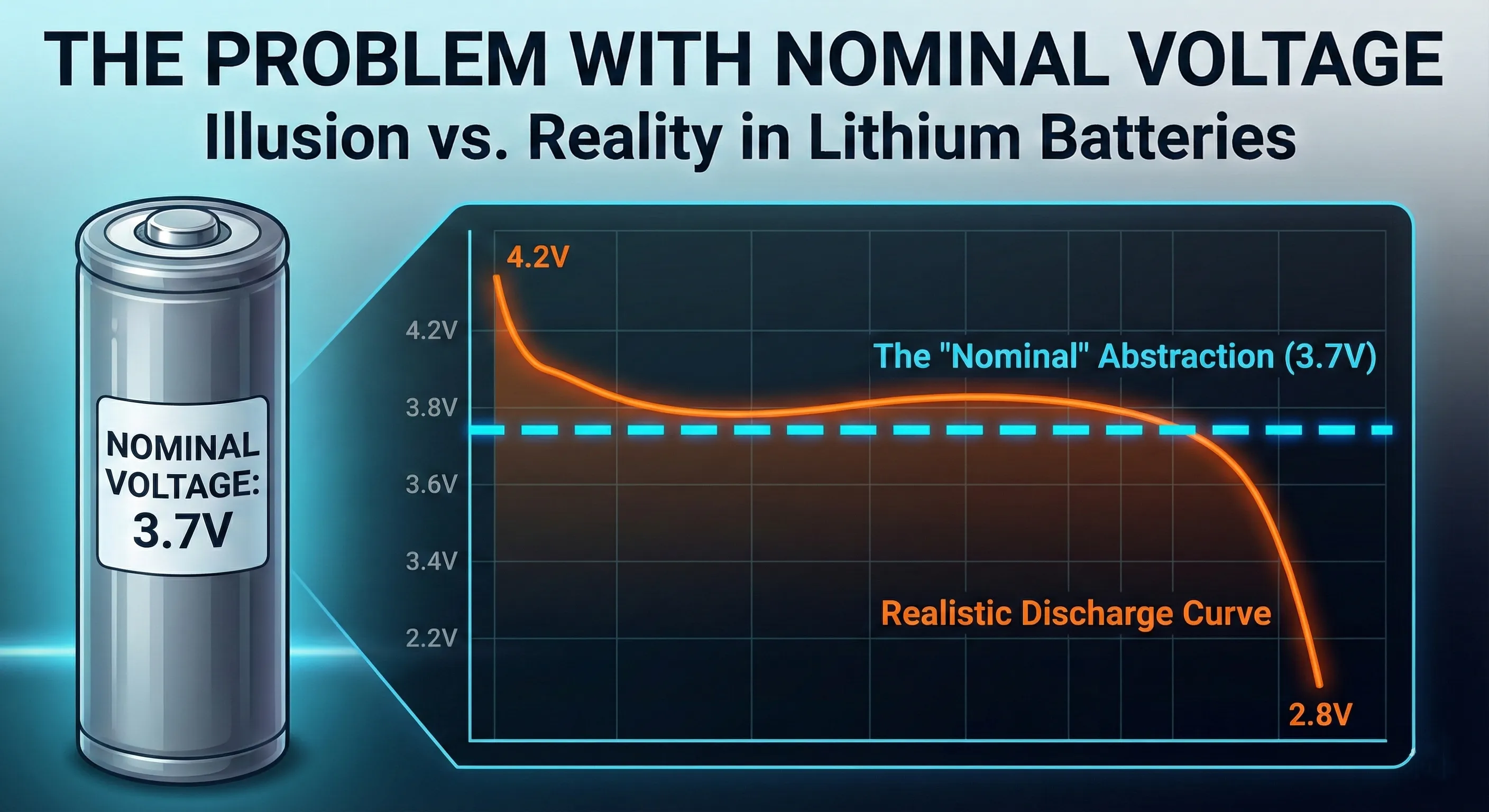
Nominal voltage is the average voltage the discharge curve will produce if you consider the starting voltage and the ending voltage and the entire discharge discharge curve and if you do the math and calculate it you'll supposedly come to 3.7 volts with the latest batteries. It used to be 3.6 volts but that's when battery technology was less advanced and they had a higher resistance.
But Here's The Important Part
But here's the important part: this “average” is not a true average in the mathematical sense for all chemistries, and it’s definitely not the same between manufacturers. Some companies choose slightly different cutoff voltages, some cells sag more under load, and some discharge curves are flatter than others. The “nominal” value becomes less of a scientific measurement and more of a marketing convenience.
If you look at a full discharge curve for an NMC cell, the voltage is not spending any meaningful amount of time at 3.7 volts. It starts at 4.2, quickly drops into the high 3s, then slowly glides down through the low 3s until it hits somewhere around 3.0 or 2.8 depending on who’s spec sheet you believe. The actual time spent anywhere near 3.7 volts is almost incidental. That’s why calling it the “nominal voltage” is almost comedic, it’s like picking a random point on a hill and calling it the “nominal elevation.”
Lithium iron phosphate (LFP) takes this absurdity even further. LFP cells have a very flat discharge curve, hanging out near 3.2 to 3.3 volts for most of the cycle. So why is their nominal voltage listed as 3.2 when the cell barely moves from that plateau? Because someone, at some point, drew a line and said, “Sure, that’s nominal enough.”
Nominal Voltage As A Communication Tool
Despite all this, the idea of nominal voltage isn’t useless. It does serve a practical function: it lets you compare battery chemistries without diving into the weeds of charge curves, current draw, internal resistance, temperature effects, or any of the other real factors that actually determine compatibility.
Nominal voltage is like a sticker on a fruit that says “apple.” It doesn’t tell you if it’s tart or sweet, if it’s fresh or mealy, or whether it’ll bake well in a pie. But it gets you into the right section of the grocery store.
So nominal voltage gets you into the right aisle of electronics. It’s not going to blow up your project if you understand the limitations, but it can definitely mislead you if you take it literally.
Why It Matters
In practical terms, if you’re designing a battery system, you absolutely cannot rely on nominal voltage. You need to look at:
• Maximum charge voltage
• Minimum safe discharge voltage
• Voltage sag under expected load
• Temperature performance
• Internal resistance
• The shape of the curve across the entire cycle
Those numbers will tell you what your device or inverter or charge controller is actually going to see. Nominal voltage will not.
If you’re just buying a battery pack for a flashlight or scooter, sure, nominal voltage is a decent shorthand. But if you're building a solar system, customizing a battery bank, or trying to integrate lithium cells into an existing system designed around lead-acid assumptions, nominal voltage becomes more of a trap than a guide.
So, What Is Nominal Voltage?
Nominal voltage is a convenience label, not a physical property. It’s a simplification layered on top of other simplifications. It can be helpful, but only when you understand its limitations. And the moment you start treating it as an absolute truth, the moment you treat it as an actual “voltage” that means something concrete, that’s when things go wrong.
Lithium cells don't care what we call them. They don't care about our marketing charts or spec sheets or simplified numbers meant to make humans feel comfortable. They behave according to physics, not nominal voltage. And the closer we get to understanding that, the fewer surprises we’ll run into when we actually use them.