
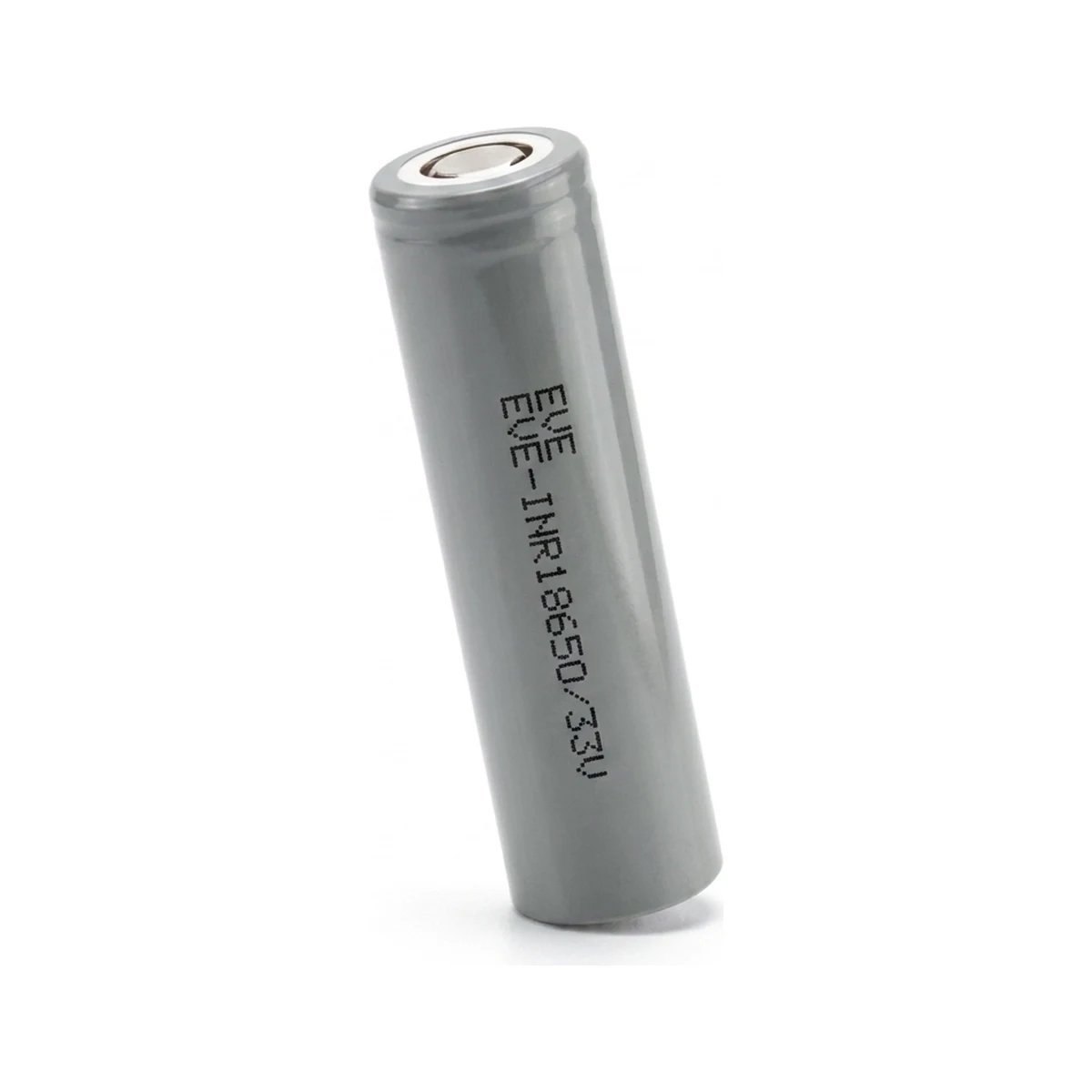
 ✱ Render
EVE EVE-INR18650/33V 18650 3200mAh 10A Cell Specs
At 3200 mAh, this ranks #23 of 279 18650 cells in our database. Near the top for capacity among 18650 cells. More capacity than 92% of 18650 cells in our database. One of the higher-capacity options.
Photos from the community
See the wrap, markings, and terminals up close.
Community photo submissions are opening soon.
Full specifications
| Electrical | |
|---|---|
| Chemistry | NMC |
| Nominal voltage | 3.6 V |
| Max charge voltage | 4.2 V |
| Discharge cutoff | 2.5 V |
| Max continuous discharge | 10A (Mooch-tested) |
| Mooch CDR (trusted) | 10 A |
| Standard charge current | 1550 mA |
| Standard discharge current | 620 |
| Internal resistance | 30 mΩ |
| Physical | |
| Form factor | 18650 |
| Dimensions | 18.35mm × 65mm |
| Weight | 48 g |
| Top type | Flat Top |
| Protected | No |
| Wrap color | Gray |
| Performance | |
| Capacity | 3200 mAh |
| Energy | 11.52 Wh |
| Specific energy | 240 Wh/kg |
| Energy density | 670.16 Wh/L |
| Power density (gravimetric) | 750 W/kg |
| Power density (volumetric) | 2,094 W/L |
| Year released | 2021 |
| Operating Limits | |
| Charge temp | 0°C to 55°C |
| Discharge temp | -20°C to 70°C |
Independent test data: Mooch's test of the EVE-INR18650/33V ↗
At the standard 1550 mA charge rate, a full charge takes about 2.1 hours. The last bit is a slow taper to top it off.
Voltage operating window
2.5VNominal
3.6VMax charge
4.2V
Usable range: 1.7V
C-rate conversion: EVE EVE-INR18650/33V (3200mAh)
| C-Rate | Current (A) | Theoretical runtime |
|---|---|---|
| 0.2C | 0.64 A | 5h 00m |
| 0.5C | 1.6 A | 2h 00m |
| 1C | 3.2 A | 1h 00m |
| 2C | 6.4 A | 30m |
| 3C | 9.6 A | 20m |
Highlighted row is closest to the rated 10A continuous discharge.
Charging
| Rate | Current | Estimated time |
|---|---|---|
| 0.5C | 1,600 mA | ~2h 00m |
| 1C | 3,200 mA | ~1h 00m |
These are estimates for the constant-current phase. Real charge time is a bit longer because of the slow taper at the end.
Datasheet
Pack scaling
Series voltage configurations
| Config | Nominal V | Max V | Min V | Common use |
|---|---|---|---|---|
| 1S | 3.6V | 4.2V | 2.5V | Flashlights, single-cell devices |
| 2S | 7.2V | 8.4V | 5V | RC vehicles, 7.2V packs |
| 3S | 10.8V | 12.6V | 7.5V | Power tools (10.8V nominal) |
| 4S | 14.4V | 16.8V | 10V | Ebike (small), some power tools |
| 7S | 25.2V | 29.4V | 17.5V | Ebike (24V system) |
| 10S | 36V | 42V | 25V | Ebike (36V system) |
| 13S | 46.8V | 54.6V | 32.5V | Ebike (48V standard) |
| 14S | 50.4V | 58.8V | 35V | Ebike (52V high-power) |
| 16S | 57.6V | 67.2V | 40V | DIY powerwall |
Parallel capacity scaling
| Config | Capacity | Energy | Max discharge |
|---|---|---|---|
| 1P | 3,200 mAh | 11.5 Wh | 10 A |
| 2P | 6,400 mAh | 23 Wh | 20 A |
| 3P | 9,600 mAh | 34.6 Wh | 30 A |
| 4P | 12,800 mAh | 46.1 Wh | 40 A |
| 5P | 16,000 mAh | 57.6 Wh | 50 A |
| 6P | 19,200 mAh | 69.1 Wh | 60 A |
Example pack configurations
Design a custom pack with this cell:
Application suitability
Physical dimensions
Similar cells
Same format and chemistry, within ±500mAh capacity:
| Cell | mAh | CDR | Wh | Weight | Wh/kg |
|---|---|---|---|---|---|
| EVE EVE-INR18650/33V (this cell) | 3200 | 10A | 11.52 | 48g | 240 |
| Vapcell N36 | 3650 | 8A | 13.1 | 48g | 274 |
| LG LGEBMJ11865 | 3500 | 10A | 12.7 | 49g | 260 |
| LG LGDBMJ11865 | 3500 | 10A | 12.7 | 49g | 259 |
| AWT AWT 35A 3500mAh | 3500 | 35A | 12.6 | 50g | 252 |
| Epoch PROTECTED | 3500 | 8A | 12.6 | 49.1g | 257 |
Build with this cell
Frequently asked questions
Handling and safety
Lithium cells can be dangerous if mishandled. A few things to keep in mind:
- Never charge above 4.2V or discharge below 2.5V.
- Store cells at around 3.6-3.8V (roughly 40-60% charge) for long-term storage.
- Don't mix cells with different capacities, chemistries, or states of charge in a pack.
- Inspect wraps before use. A torn wrap can cause a short circuit.
- Always use a BMS or balance charger appropriate for your pack configuration.
- Keep cells away from metal objects, keys, and coins. A short across the terminals can cause fire.
Get new tools and build tips
We are always adding tools, cell data, and guides. Drop your email for new tool releases and battery-building tips. No spam, unsubscribe anytime.
Specs come from manufacturer datasheets and independent testing; Mooch-tested discharge ratings are shown when available because they reflect real continuous performance better than headline datasheet numbers. Browse the full 18650 & 21700 cell database to compare every cell.
Disclaimer: We do our best to keep the information on this page accurate, but we cannot guarantee that all specifications are correct or up to date. Cell characteristics can vary between production batches and may change over time. Do not rely solely on this data for safety-critical applications. Always verify against the manufacturer's official datasheet before use.